Open Jane Austen's Emma to the scene after Mr. Elton's proposal in the carriage, and read the paragraphs where Emma sits alone thinking it over. The narration stays in third person. There are no quotation marks and no "she thought." Yet the sentences are plainly Emma's, full of her exclamations and her particular way of excusing herself. "The hair was curled, and the maid sent away, and Emma sat down to think and be miserable. It was a wretched business indeed! Such an overthrow of every thing she had been wishing for!" (Austen's dashes are dropped here for readability.)
That last pair of sentences is not the narrator's opinion. It is Emma's, delivered through the narrator's mouth. The technique is called free indirect style, or free indirect discourse, and once you can hear it you will notice it in most modern fiction.
What it is
There are roughly three ways to give a character's thought:
- Direct: She thought, "This is a disaster."
- Indirect: She thought that it was a disaster.
- Free indirect: It was a disaster.
The third version drops the tag and keeps the grammar of narration, past tense and third person, while taking on the character's vocabulary, emphasis, and judgment. The reader hears both voices at once. That doubling is the point.
Literary critics have long associated the technique with Austen in English and with Gustave Flaubert in French, especially Madame Bovary. James Wood, in How Fiction Works, calls it one of the central tools of the modern novel.
Why it matters for voice
You might be thinking this is a grammar curiosity for literature classes. For a working writer, it is a dial. It lets you move the narration closer to a character for a line or a paragraph, then pull back, without changing point of view or breaking into italics.
It also lets you write a character's voice when the narrator's voice is different. A narrator can be measured and dry while a teenage character's slang leaks through in a single word. "The party was, honestly, a total waste." That "honestly" and "total" belong to her. The rest belongs to the book.
It also smuggles irony. The reader hears two voices, so the narrator can let a character's self deception sit on the page, unremarked, and trust us to catch it. Austen does this on nearly every page of Emma. Emma is wrong about Harriet, wrong about Mr. Elton, wrong about Frank Churchill, and the free indirect sentences let us feel her certainty from the inside while quietly watching her walk into the furniture.
How to tell whose sentence it is
A quick test: would the narrator say this word in this way? Signals that a line has shifted into free indirect style include:
- Exclamations and rhetorical questions. What was she supposed to do now?
- Words or slang that fit the character, not the narrator.
- Judgments the narrator would not make. The man was obviously an idiot.
- Deictic words pointing at the character's here and now: tomorrow, this, now, inside past tense narration. Tomorrow she would tell him.
Two or three of those in one sentence and you've crossed the threshold into the character's head.
Common problems
Drift without control. If every paragraph slides into the character's diction, the narrator disappears and the book loses the ability to step back. Decide when you want closeness.
Confusing ownership. In a scene with two characters, a free indirect sentence can seem to belong to either. Anchor it with a nearby action or a name. Sam looked at the clock. Ten more minutes of this.
Using it to dodge. Free indirect style is not a way to avoid writing dialogue. If a thought would be said aloud, let it be said.
An exercise
Take a page of your own third person draft where a character is alone and thinking. Find every sentence with a thought tag: she thought, he wondered, she realized. Remove the tag from three of them and rewrite each in the character's own words, keeping past tense and third person. Read the page aloud before and after.
If the revised page sounds more like the person, keep it. If it now sounds like nobody, put one tag back to orient the reader and try again.
Your next step is to reread one favorite novel's opening chapter with a pencil and mark every sentence you think belongs to a character rather than the narrator. Ten minutes of that will teach your ear more than any definition, and then you can try the same move in your next scene.
Sources
- Jane Austen, Emma, Project Gutenberg edition
- James Wood, How Fiction Works (Farrar, Straus and Giroux, 2008)
- Encyclopaedia Britannica, Stream of consciousness and related techniques
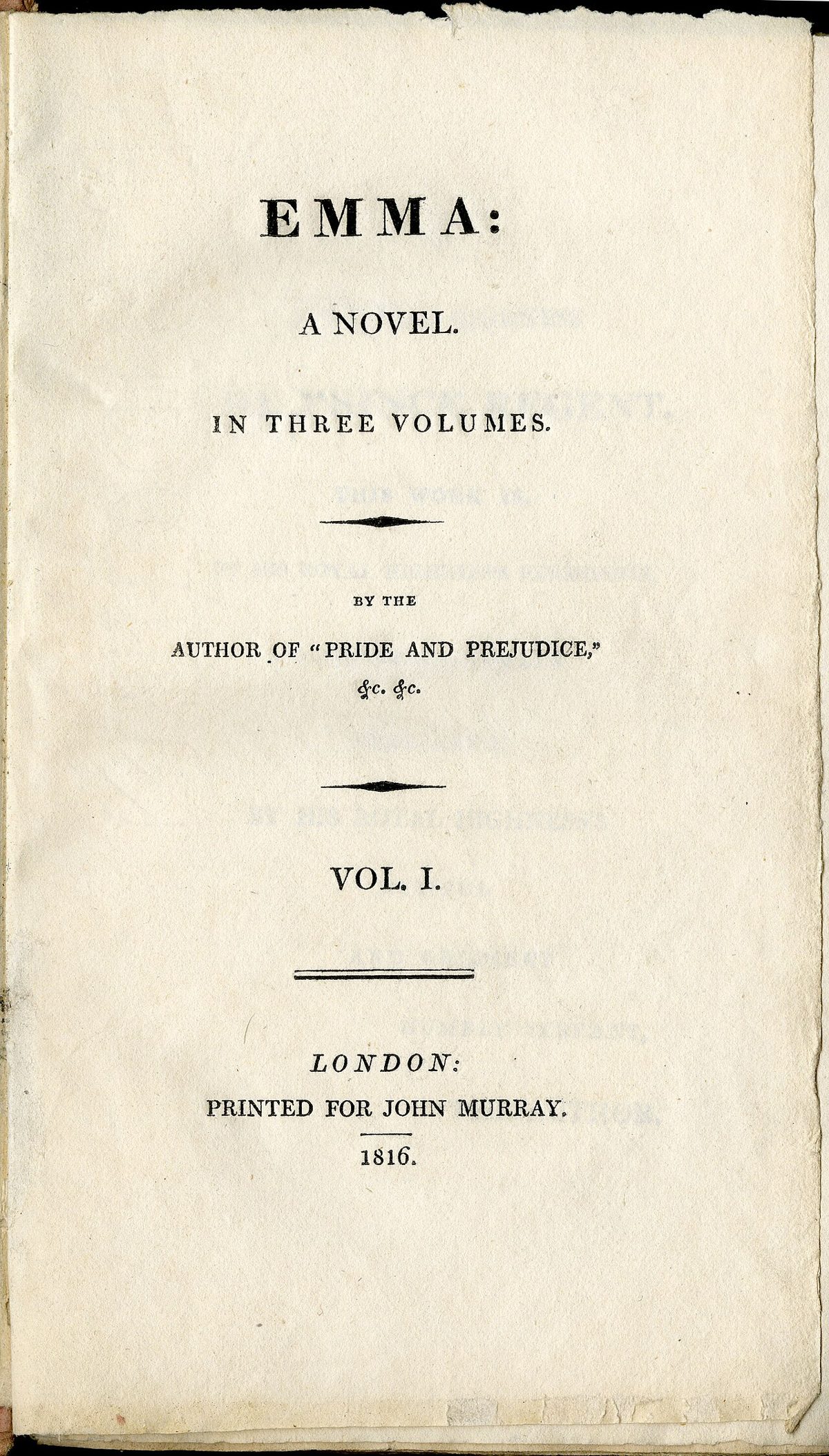
Image: EmmaTitlePage, Jane Austen. Public domain, via Wikimedia Commons.