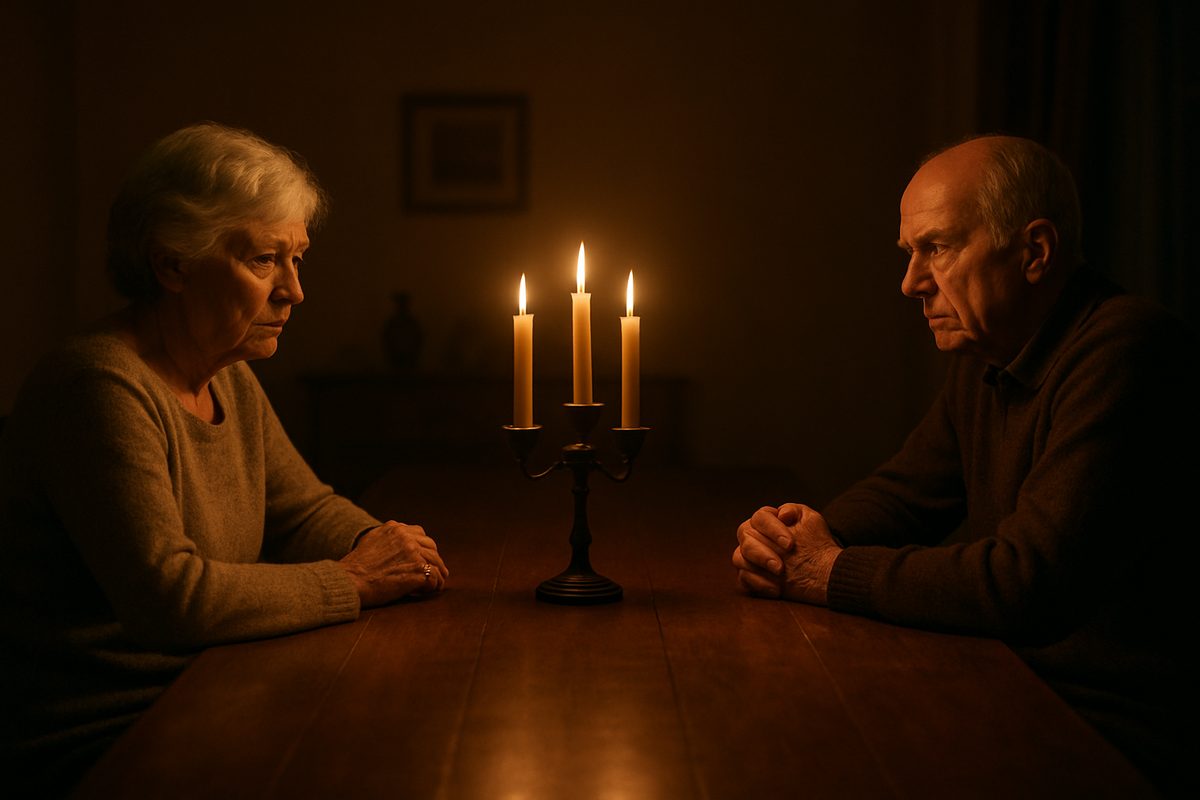
Two people argue about the dishes, and by the end of the page you know the marriage is in trouble. A parent asks about the weather, and the question carries years of disappointment. Nothing in the spoken lines says "marriage" or "disappointment." The meaning sits underneath. That underneath is subtext. It is not a trick you sprinkle on a finished scene. It is what happens when a person cannot, or will not, say the true sentence, and the story has given the reader enough to hear it anyway.
Ernest Hemingway, in Death in the Afternoon (Scribner, 1932), writes about omission: a writer who knows what is being left out can leave it off the page, and the reader still feels the pressure of the missing part. He is talking about knowledge, not about being vague. If you do not know what the scene is withholding, the reader will not feel a hidden meaning. They will feel a blur. Subtext is omission with a design.
The gap has to come from somewhere
Subtext appears when there is a distance between the true want and the allowable sentence. That distance has a few common sources, and it helps to know which one you are using.
- Manners and rank. People do not say the true thing to a boss, a parent, a guest, or anyone they cannot afford to lose. The room has rules. The rules are the reason the dialogue looks like small talk.
- Self-protection. Shame, pride, and the fear of being left will keep a true sentence in the mouth. The character is not playing a literary game. They are trying not to be hurt.
- Not knowing. Some characters cannot name their own feeling yet. The reader may be ahead of them. That is a clean form of subtext, and it collapses if you add a sentence that explains the feeling the character has not reached.
- Strategy. Someone is lying, recruiting, or delaying. The hidden meaning is a plan. The reader should eventually be able to see the plan, or the scene is only confusion.
- Shared history. People who know each other well speak in shorthand. A single noun can mean a whole old fight. Outsiders in the scene, and readers, need at least one earlier glimpse of that fight or the noun is private to you.
If your characters say exactly what they feel as soon as they feel it, the gap closes. Some scenes should close it. A book in which nobody ever says the true thing becomes a long tease. Subtext is a tool you set down when the story has earned a plain sentence.
The spoken side of this craft is dialogue that reveals character. Dialogue is the surface. Subtext is why the surface is shaped the way it is. You can revise them together, but do not treat them as the same note. A distinct voice in the lines does not guarantee a second meaning. A second meaning can exist in narration even when the talk is plain.
Six ways to carry what is not said
Displacement. The fight happens on a safe subject: the thermostat, the errand, the way someone loads a dishwasher. The safe subject has to be able to hold the real one. A thermostat can hold control, neglect, who pays the bill. It cannot hold every theme in the novel. Pick a displacement that has a natural bridge to the stake, then stay on it longer than feels comfortable. The length is what tells the reader this is not about dishes.
Evasion. A question is answered with a joke, a counter-question, or a change of topic. The reader notices the swerve if the question was clear. If you swerve in every line, the scene becomes a mannerism. Use evasion where the cost of a direct answer is visible.
Action against the words. "I'm fine" is nothing. "I'm fine" while someone scrubs a clean pan, or while someone packs a bag with too much care, is a scene. The body contradicts the sentence. You do not then write "she was not fine." The contradiction is the line you already wrote.
Objects. An empty chair, a ring left on a sill, a drawing still on a fridge after the child is grown. Objects hold feeling so the dialogue does not have to name it. One object, repeated, is stronger than a room full of symbols. If you explain the symbol in the next paragraph, you have spent it.
Omission of the obvious reaction. Terrible news arrives, and the character asks whether anyone wants tea. The reader supplies the shock, provided you have shown us a character who would normally react another way, or a room in which tea is a delay. Omission without contrast reads as coldness you did not intend. Give the contrast earlier, quietly.
Knowledge the reader has and the character does not. Once the reader knows a secret, ordinary lines pick up a second edge. This only works after the secret is actually on the page. Hinting that a secret exists, without ever letting the reader hold it, is not dramatic irony. It is a promise you are late in keeping.
You will not use all six in one scene. A scene that tries to is usually showing off. Choose one or two carriers and let them repeat.
The reader needs ground under the gap
Subtext fails in two directions. The first is explanation after the fact: a restrained exchange, then a paragraph that says what the exchange "was really about." Cut the paragraph. If the scene dies without it, the scene was not carrying the meaning, and you should rebuild the carrier rather than keep the gloss.
The second failure is thin air. You withhold the true subject, and you also withhold any prior scene that would let a reader guess it. Subtlety becomes a private code. The fix is not to explain in the moment. The fix is to plant the tension earlier: a decision, a lie, a desire, a fact about money or the body. Then the later scene can afford to talk about something else.
A useful order: write the true sentence for yourself, in the margin, in plain words. "She feels abandoned." "He wants permission to leave." Remove any spoken line that states that sentence. Choose the carrier. Then walk back two chapters and make sure the true sentence is already implied by an event. If it is not, add the event, not a speech.
How close the narration sits changes what you are allowed to withhold. In a close third person, a thought can give the game away. If the point of the scene is that the character will not admit the feeling even privately, you cannot also narrate the feeling in the character's own words. Pull the thought back, or the subtext is only pretend. In a more distant voice, you can withhold more, and you must offer the reader other evidence: gesture, timing, what the character does next.
When to be plain
Some scenes should say the thing. A long-delayed honesty lands because earlier scenes were full of avoidance. If you have been oblique for two hundred pages, a plain sentence is the event. Do not bury it under another metaphor out of habit.
Plainness is also right when the reader cannot be asked to guess a plot fact. Subtext is for motive, fear, desire, and the social lie. It is a bad place to hide the rule the mystery depends on, or the medical reality a later choice requires. You can be indirect about how a character feels concerning a fact and still put the fact in a sentence someone could repeat accurately.
There is a vanity version of subtext in which every character speaks in riddles so the author can seem shrewd. Readers experience it as same-voiced cleverness. If you cover the names and the lines could be spoken by anyone, you do not have subtext. You have a tone. Go back to wants. People evade in character-specific ways: one bargains, one goes silent, one becomes excessively polite, one attacks a smaller target. Those differences are the same differences that make dialogue audible with the tags covered.
A scene you can build this week
Write two siblings clearing a dead parent's house. They may talk about boxes, furniture, and who drives home. They may not talk about which of them left and which of them stayed. By the end, the reader should know the old rivalry anyway, because of who picks up which object, who mentions a buyer, who will not sit in a particular chair.
Then give the scene to one reader and ask what it was about besides the boxes. If they can say, leave the scene alone. If they cannot, add one earlier detail or one contradictory action. Do not add a confession unless you have decided the confession is the point of the scene. Most of the time the boxes were enough and the groundwork was missing.
After that, try the reverse exercise so you do not become superstitious about indirectness. Take a scene in which two people finally tell the truth. Make the truth a full sentence. Watch how much pressure that sentence borrows from the evasions that came before. If it borrows none, the earlier evasions were decoration. If it borrows a lot, you have been writing subtext for a reason, which is the only good reason.
A limit worth stating
Subtext will not create a relationship you have not dramatized, and it will not make a cruel character kind. It also will not survive a narrator who explains motives in the same breath as the gesture. If you love the explanatory sentence, admit that you are writing a more essayistic distance and do it consistently. A knowing narrator can discuss motive in their own voice. That is a different contract from a scene that pretends to withhold and then whispers the answer. Pick one contract for the scene.
The blog has companion notes on rhythm and distance because subtext is heard as much as it is inferred. A rushed rhythm can step on a pause the subtext needed. A sudden close-up can reveal a thought you meant to keep in the hands. When a scene feels both obvious and muddy, check those two layers before you add another symbol.
The resources library is there if you want books that argue with this one. Use them to test the method, not to collect synonyms for "show, don't tell." That slogan is too blunt for this job. You are deciding what is said, what is done, and what the reader can be trusted to hold. Those are three different decisions.
Your next step: write the true sentence of a scene in the margin, cut any line that repeats it, and give the scene one carrier — an object, a swerve, or a contradiction. Read it the next day and ask whether a stranger could feel the true sentence without being handed it.