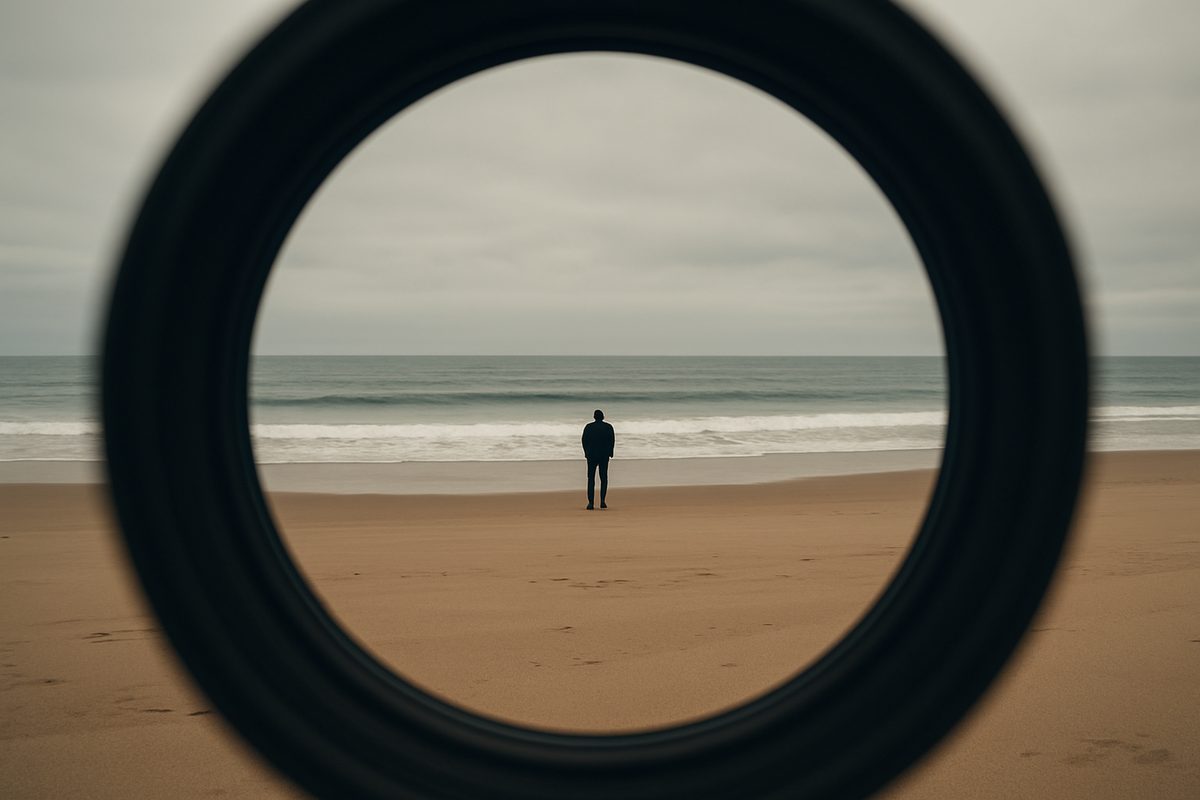
Some novels put you in the room so thoroughly that a stray thought feels like your own. Others keep you on the hill with a guide who knows more than any one person in the valley. Readers describe that difference as voice, and they are partly right. A large part of it is distance: how close the narration sits to a consciousness. Distance is adjustable inside a single chapter. When you adjust it by accident, the prose feels unsteady even if every sentence is locally fine.
John Gardner, in The Art of Fiction (Knopf), calls this psychic distance, the distance the reader feels between themselves and the events. A clear summary of his scale, including why sudden jumps tend to throw people, is on the University of Nevada, Reno writing center page on psychic distance. Gardner's examples are his; what matters for your draft is the idea of a scale, and the warning that leaping from a wide shot to a thought and back again, without a reason, looks like the camera was dropped.
Distance is not the same thing as point of view, though they travel together. A third-person sentence can be pressed against a mind. A first-person narrator telling a story from years later can stand quite far from the person they were. If you came here for the choice of who speaks, the companion is how point of view shapes voice. This page stays with nearness.
A scale you can hear
Think of the camera moving, and listen to the diction change with it.
- Far. The sentence summarizes a time, a town, a winter. It can know things no single citizen knows. The vocabulary belongs to the narrator, not to a person in the street.
- Watching. We see a body in a place. "She stood at the window with her coat still buttoned." We are not yet in the thought, but we are in the room.
- Attributed thought. "She thought the snow would never stop." The feeling is named from a half-step outside.
- Free indirect. The thought's diction takes over the sentence without a "she thought." "The snow would never stop. Nothing in this town ever did what it was supposed to." We are using her words, including her unfairness.
- Deep interior. Syntax loosens. Sensation crowds out report. Used for long, it exhausts. Used at a peak, it can feel like the only honest distance.
You do not need five gears in every story. You need to know which gear you are in, because the gear changes what counts as a legal sentence. A far narrator may generalize. A free-indirect sentence that generalizes in a professor's vocabulary, while the character would never talk that way, pops the reader out of the mind you just entered. The pop is the unintended shift.
What each distance is good for
Distance is a choice about the reader's job.
Far narration can carry time, irony, and the shape of a life. It can also go cold if you use it to avoid the scene you are afraid to write. If every grief arrives as a summary, the reader may understand the story and never feel invited.
Middle distance is the workhorse. It can show a room and allow a thought. It is also where prose goes to hide, because it offends no one. If a whole book sits there, ask whether you are choosing calm or choosing not to decide.
Free indirect style is where a lot of contemporary voice lives. The sentence sounds like a person without the tax of constant "I" or constant "she thought." The risk is claustrophobia, and the risk of cheating: smuggling in a fact the character could not know, or a judgment the character would not make, while still pretending we are in their words.
Deep interior can do panic, lust, grief, and obsession. It is a poor vehicle for instructions, geography, and the kind of plot information a reader must not miss. If you bury a clue in a sensory rush, do not be surprised when the clue disappears.
A rough way to hold it:
| Distance | What it offers | What it costs |
|---|---|---|
| Far | Scope, irony, time passing | Feeling can arrive as information |
| Watching | A body in a place, clear action | Interior life has to be inferred |
| Attributed thought | Clarity about whose feeling it is | The "she thought" can feel like a label |
| Free indirect | Intimacy and a spoken rhythm | You are limited to that mind's knowledge and diction |
| Deep interior | Intensity | Fatigue, and easy confusion about facts |
The table is a reminder, not a sequence you must climb. Some books pick one row and stay there. Gardner's point, as the Nevada summary frames it, is that the setting should be controlled. A single distance for a whole story can feel icy or airless, and that can be the effect you want. An uncontrolled mix feels like an error even when you meant it as energy.
Move for a reason, and usually by steps
A reliable shape, not a rule: open a little wider than the peak, come closer as the pressure rises, go close at the moment of decision or harm, then pull back when you need time to pass or a consequence to land. The pull-back is not a failure of nerve. It is how a story breathes. A book that stays in deep interior for every errand makes the errands hysterical. A book that stays far during the one scene that had to be lived makes the climax into minutes.
Large jumps need a joint. White space can be a joint. A change of chapter can be a joint. A single bridging sentence can be a joint. What rarely works is a far sentence, then a fragmented interior, then a far sentence, inside one paragraph, unless you are comic and the jump is the joke. Comedy gets to be ruder with distance. Even then, the rudeness should be repeatable enough to feel like a style.
Filter verbs are the small mechanical version of this problem. "She noticed," "he felt," "she saw," "she realized" place a pane of glass between the reader and the thing. In a close passage, "The door slammed" is nearer than "She heard the door slam." In a far passage, the filter may be honest, because a distant narrator is always a little outside. Delete filters when you are trying to be close. Keep them when you are trying to remind us that perception is limited. Deleting all of them by policy will drag a distant book into a closeness it did not earn.
Diction has to agree with the distance
Close narration borrows the character's vocabulary, including their bad logic. Far narration may use words the character does not own. The common glitch is a close passage that suddenly sounds like an essay: "The precarity of her situation became legible." If she would not think "legible," the sentence has stepped out of her head without admitting it. Either step out on purpose and stay out for a while, or rewrite the sentence in the words the distance promised.
The reverse glitch is a far narrator who starts using a character's pet phrase without having moved in. One phrase can be a quote. A paragraph of mimicry is a move to free indirect, and you should commit to it or back out.
Sentence rhythm usually changes with distance, too. Minds under pressure often produce shorter units or a long sentence that will not land. Summaries often even out. If you change distance and keep an identical cadence, the zoom is theoretical. Read the passage aloud. The ear will tell you whether you actually moved.
Dialogue, subtext, and the thoughts you allow between lines
Distance decides how much private correction the reader hears during talk. Very close narration can contradict a spoken line immediately, which is powerful and easy to overuse. If every line is undercut by a smarter thought, the character becomes a commentator on their own scene and the subtext has nowhere to hide. The reader is no longer inferring. They are being briefed.
A farther narration lets the spoken line stand. Inference becomes the reader's work, which means you owe them evidence in gesture and consequence. Choose the distance before you decide how clever the unspoken layer can be. A close mind that already knows its own subtext is not really withholding.
A practical pass on one scene
Take a scene that feels both important and muffled. Mark every sentence as far, watching, attributed, free indirect, or deep. You will see the places you lost your nerve. Often the emotional peak is the paragraph that jumps backward into summary, because summary is safer to write. Rewrite that paragraph one step closer than the paragraphs around it, not five steps closer. Then read the scene aloud and listen for diction that belongs to a different row of the table.
Rewrite the same peak once from a farther seat, as a clean exercise, even if you do not keep it. The far version will show you which facts are doing the work and which feelings you were faking with adjectives. Then return to the closer version and keep only the feelings the far version proved were necessary. This is slower than a single "make it vivid" pass. It is also how you stop adding intensity with nouns like "heart" and "soul" when the distance was the actual problem.
Limits
Distance will not supply a motive. Moving closer to an empty decision just gives you a more intimate view of the emptiness. Moving farther from a cruel act can be honesty or can be a cover. If you notice that you only go far when a character does harm, ask whether you are protecting the reader or protecting the character from being seen. Those are different ethics, and only one of them belongs to the scene.
A controlled distance is also part of what people mean when they say a book has a voice. The voice triad notes are one way this site talks about pattern across a manuscript. Distance is a pattern you can mark with a pencil. You do not need a new personality to change it. You need to decide, scene by scene, whether the reader should judge, inhabit, or simply watch.
Your next step: mark one scene with the five distances, and rewrite only the peak so it sits one step closer than the sentences around it. Read that page aloud. If the diction still belongs to a narrator the character would not recognize, change the words before you change anything else.